What Are You Implying?

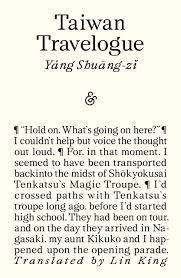
The middle part of Yang Shuang-zi’s Taiwan Travelogue shows a slow escalation of the themes introduced during and after the book’s inciting incident. Aoyama is increasingly attracted to O-san, and vice versa—seemingly, although this is put into question later. After all, it’s all presented through Aoyama’s perspective. And there’s a strong sense of Aoyama being outraged by the racism shown to the Taiwanese by the Japanese, although, again, this is later re-contextualized.
There is a strong presence of the implied author, more so than in other books. Just for a fun review, the implied author refers “to the textual, reconstructed "persona" or "second self" of the writer, distinct from the actual, flesh-and-blood author. It is the version of the author inferred by the reader based on the style, ideology, and tone of the work.” Ideology in this book refers to beliefs expressed about the insensitivity of certain people from Japan who look down on the Taiwanese and wish to dominate their country—beliefs that are shown in a negative light. The style and tone of Taiwan Travelogue is realist; the book seems very much like the chronicle of a “real” person, Aoyama, who narrates her adventures on the island of Taiwan in 1938. However, below the surface, we discern that this is all “magic” and of clever design, the work of the entity who wrote the book. Isn’t this Ms. Yang? you ask. The concept of the implied author involves the idea that the real Ms. Yang is capable of writing other books (she actually has) and that these other books may vary in style, ideology, and tone. Taiwan Travelogue is a particular novel, a one of a kind creation by an entity who goes to elaborate lengths to disguise the fictional nature of the work, creating introductions and afterwards, peppering the text with many footnotes that add to the illusion that the text is a sort of memoir or travelogue based on “real” events instead of being a contemporary novel.
The footnotes are often credited to the book’s translator, Lin King, sometimes to the author, Yang Shuang-Zi, and sometimes even to the narrator, Aoyama. Lin King may indeed be another implied author who shapes the translated narrative and provides extensive commentary on the text, with notes on food, historical and natural sites, and poetry. I believe she is a “real” flesh and blood human.
The first footnote occurs on page 1 and is credited to Yang Shunag-zi, described as the “Mandarin Chinese translator of the 2020 edition.” ‘Kay. This is intentionally misleading. Ms. Yang is the real author, not someone who translated an already existing text. Subsequently, she and the English translator, Lin King, take turns adding footnotes which continue to support the fiction that the book was actually written in 1954 and that it refers to real events in 1938. These footnotes, unusual in a work of fiction, provide a false sense that the novel is a memoir. On page 75, we actually have a footnote from the narrator, Aoyama, who explains some details of Taiwanese cuisine. This, I must remind everyone, is a footnote by a fictional character. “What’s going on here” indeed.
Mid-way through, we have our old friend a mise en abyme.
Aoyama and Chi-Chan visit a girl’s school and are introduced to two young students, Ozawa Reiko, a Japanese girl, and Tan Tshiok-bi, (sparrow), a Taiwanese, as they stand outside beneath a flowering bougainvillea tree. “One of the girls, who had the build of a star athlete, raised a hand to brush the fallen petals off the shoulder of the shorter, slighter girl.” This physical description is quite similar to the description of Aoyama and Chi-chan, and this gesture of the larger girl brushing fallen petals off the slighter girl’s shoulder is congruent with the way that Aoyama wishes to protect Chi-chan.
That night, they sleep in one of the girl’s dormitories, near a bathroom which is rumored to be haunted or enchanted by spirits. “There are tales about a mythical dimension in the lavatory,” Tan Tsiok tells them with a mischievous smile. Of course, this is all Aoyama and Chichan need to hear. In the middle of the night, they go to the bathroom and hear voices. They discover a photo lying on the floor of a very thin and boyish young woman. Things are mysterious and shadowy, but it develops that two girls have been using the bathroom as a romantic rendezvous, as it is a safe place others are afraid to go to at night.
This is a mis en abyme indeed, best B, one that presents Aoyama’s desire of the way things should be between she and Chi-chan.
‘Kay. We’ve brought things up to a point where the novel changes significantly in a sort of climax—a drawn out one. Let’s stop there and pick up next time.
Till then.
Comments