Taiwan Travelogue

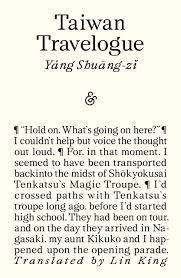
This week, a new and very interesting book, dear friends, Yang Shuang-zi’s 2020 novel, Taiwan Travelogue. Originally published in Taiwan, this book has been short-listed for the 2026 International Booker Prize and was translated to English by Lin King in 2024.
What the heck is very interesting about this novel? you say. Well, on the surface, it appears to be a reprint of an old travel book about a Japanese woman visiting Taiwan in the late 1930s. The publisher has taken pains to encourage this idea with the book’s cover design and layout. The cover of the English edition I’m reading quotes the first page of the purported “travelogue” which begins, “Hold on. What’s going on here?” The quoted text presents the narrator describing a parade of magicians she once saw, and this description of magic and sleight-of-hand is a wry commentary on the whole book. The text itself has a generous sampling of descriptions of Taiwanese cuisine and shows the protagonist/narrator, and her companion visiting numerous tourist sites—features common to many tourist guides, or travelogues.
However, below the surface, we have a novel.
By way of background—which does help in one’s enjoyment—"From 1895 to 1945, Japan colonized Taiwan, transforming it into a "model colony" to support its imperial expansion. While implementing strict, often brutal, authoritarian rule and cultural assimilation (Japanization), Japan concurrently built extensive infrastructure—railways, sanitation, and education systems—that modernized the island's economy, particularly in agriculture and industry.”
Japan was forced to give up Taiwan after WWII, and currently, Taiwan is a sovereign nation (China is not pleased).
Today, let’s consider the book’s introduction that seems to be separate from the story. In fact, I began reading the book by skipping this section, thinking I’d get at it later, that it was exactly what it purports to be, an introduction written by someone else. It’s entitled, Introduction to Taiwan Travelogue, New Mandarin Chinese Edition, 2020.
Then we have, A Truncated Dream, A Foreign Splendorland and the author’s name, Hiyoshi Sagako. (I wonder if this name has some meaning in Japanese culture—or Taiwanese).
“My affiliation with this new translation of Taiwan Travelogue began in 2015, when I heard via word of mouth that Ms. Yang Jo-hui, a translator, was seeking a copy of the first Mandarin translation, published in 1977. I found this an unusual quest, considering that the book had been out of print in Taiwan for many years…”
‘Kay, what’s going on here? (To echo the text’s first line). On the publication page, we’re told simply that Ms. Yang wrote the book in 2020, so how could it now be said to have been written much earlier, in 1954? The writer claims that in 1938, a Japanese woman, Aoyama Chizoku, a famous novelist, was asked by the Japanese government to travel to Taiwan and write a series of dispatches describing the island. She did so amid the build-up to WWII, publishing the dispatches first as a travelogue. Then in 1954, she published a novel based on her experiences.
A nice story, but—you guessed it—a fiction. The novel, Taiwan Travelogue, was indeed written by Yan Shuang-zi in 2020, and the translation is now nominated for a Booker Prize.
Why do these literary acrobatics? you ask.
The concept of time travel comes to mind, as well as the work of magicians. As does that old idea of a text’s implied author.
The introduction continues with a summary of one of the main themes of the book, that Taiwanese—including those born of Japanese families living on the island—were looked down on by people in Japan as inferior and, in the case of ethnic Japanese inhabitants, not “really” Japanese. Here we have another theme—authenticity vs. inauthenticity. Fiction vs. non-fiction. Ms. Aoyama’s being invited to Taiwan to write a Travelogue is characterized as an attempt by the Japanese government to further their expansionist ambitions (think Pearl Harbor).
In a very curious passage, the authenticity of Ms. Aoyama’s interpreter, Ms. Wang Chien-ho, is questioned:
“I will admit that, back when I first read Aoyama-sensei’s serialized essays, I had assumed that Ms. Wang must have been a fictional character…I therefore deduced that Ms. Wang must have been a clever metaphor, a vessel through which Aoyama could imply her true views under the veil of patriotic writing.” This passage of course is based on the fictional idea that Ms. Aoyama is a “real” person, instead of a fictional character.
The introduction continues: “Today, there is no longer any doubt that Ms. Wang was very real indeed; those who attended Ms. Aoyama’s lectured testified to seeing Ms. Wang at her side. But while Aoyama’s motives for publishing the book were rooted in her relationship with the real Ms. Wang, she ultimately chose to present the work as fiction, and the novel’s very premise rests on the fictionality of Ms. Wang as a character. For better or worse, Ms. Wang has become a metaphor—one without which the novel Taiwan Travelogue cannot stand as a work of literature.”
‘Kay. Once again, on the surface, this seems quite plausible, but when you consider that Taiwan Travelogue is a work of fiction published in 2020, the introduction becomes a hall of mirrors. Ms. Yang is real/not real. The book is fiction/not fiction. Why does the novel’s very premise rest on the fictionality of Ms. Wang? The author (implied author) is saying that the character of Ms. Wang is symbolic of the racism and oppression that Japanese people inflicted on the Taiwanese.
The introduction then comments on the insertion of a key chapter after the first publication of the novel. We’ll get into that later.
As a preliminary step toward making sense of this story, let’s say that it’s form—here, the introduction—conveys a lot of information.
Let’s stop there and continue next time.
Till then.
Comments