Noh Demons

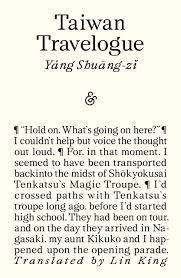
In Yang Shuang-zi’s Taiwan Travelogue, the story continues in a somewhat playful tone through the middle section of the book. The narrator. Aoyama, describes a chaste infatuation with her interpreter/companion, Chi-chan, who remains inscrutable. Around page 174, after learning that Chi-chan faces an unhappy arranged marriage with an older man who will expect her to do nothing more than produce sons, Aoyama asks her to come to Japan with her, where they will live together, and Chi-chan can pursue her desire to be a translator. There is no overt evidence of Aoyama hoping for romantic involvement, but plenty of eroticism. But Chi-chan refuses. Here, Aoyama remarks on something she has noted throughout the story so far, that Chi-chan seems to wear a Noh mask, meaning she is impossible to read. “Noh masks (noh-men or omote) are carved wooden masks worn in traditional Japanese Noh theater, originating in the 14th century. They represent demons, spirits, women, and gods, crafted from Japanese cypress and painted with natural pigments.” Aoyama becomes angry, deciding that Chi-chan has led her on, flirted with her, encouraged a one-sided intimacy. Chi-chan has played a role; she is not whom she seems to be, which, of course, is a central theme of the story.
Here is a scene with the two women, beginning with Aoyama:
“’Are you aware of your mask?’
‘My…mask?’
‘Can you deny that you’re wearing a mask right now? You’ve hidden your true feelings from me since the day we met.’”
Aoyama believes Chi-chan’s coldness is because Aoyama gave her a luxurious kimono—a traditional Japanese garment. By giving such an expensive gift, Aoyama believes she offended Chi-chan. Chi-chan replies: “’Liking or disliking kimonos isn’t the crux of the problem…you have a blind spot that you cannot possibly be aware of.’”
Chi-chan continues: “’I believe that it is most ideal for us to maintain a strictly professional relationship.’”
This statement leads to a separation between the two women. Chi-chan disappears, leaving Aoyama no way to contact her and a sense that she does indeed have a blind spot that she cannot see.
Let’s re-focus on how the story is told. There are few traditional flashbacks in Taiwan Travelogue; the text stays anchored in the story’s present, although as we have noted, the introductions and afterwords playfully jump all over time (mostly ahead). In the story itself, time moves essentially in one direction—forward. The story could certainly bear digressions into the past that would contextualize the characters’ behavior, however, this is not presented. Our friend the implied author has made a choice here, one that helps to define the book’s style.
Primarily, there are dramatic scenes with a helping of dramatic summary, often in imperfect tense. There are also the expository sections on cuisine.
What do I mean here?
Let’s look at an example.
“After we returned to Taichu, there was no more talk of Noh masks or of friendship. The clock seemed to have rewound to my early days on the island, with Chi-chan angelically preparing nutritious and delicious lunches and dinners for me on my writing days…A rainy season was upon us, much like when I first got here; but this was wintry rain…”
‘Kay, this is dramatic summary. We are not shown moment to moment what the narrator describes; time is collapsed and there’s a sense that the events described occur and re-occur from day to day.
Here is an example of the “travelogue” -like descriptions of cuisine.
“Back when sukiyaki was first introduced in the Meiji era, it was known simply as beef hotpot. There were originally different ways of making the dish in Kamigata and Edo, but these eventually merged in the Taisho era.” (And these passages are usually footnoted, which contributes to the verisimilitude).
Here is a dramatic scene:
“’If shuto means ‘alcohol robbery,’ then perhaps we ought to call sukiyaki ‘rice robbery,’ I said.
Chi-chan laughed. ‘Is that why you made three whole cups of rice?’
‘I would have made four, but I wanted to save some room for the meat.’ …
In the ensuing silence, I saw that the clock had not turned back after all. The Chi-chan who had heartily enjoyed the Yanagawa pot with me would not have been silent now.”
(This inner reflection is a comment on the change in the women’s relationship).
‘Will you not ask me what we’ll eat in the spring?’ I asked.
This scene begins slowly, with the discussion of food but drama arises when Aoyama asks Ch-chan about the spring, bringing up the question of whether they’ll be together in the future (they won’t).
The point is that these frequently occurring passages consist of quoted speech, with some “beats” and some inner thoughts of the narrator. (a beat is an action that a speaker of dialogue makes, a description of what they were doing as they spoke—Chi-chan laughed).
One of the primary injunctions fiction writers are given is to “show, not tell.” The reader should be asked to make meaning of a story, not have it explained to her/him. However, a story devoid of any telling or exposition would be quite challenging to understand, so a balance is needed. In the above scene, we the readers are shown Chi-chan uttering a question about how many cups of rice Aoyama made. This question could be construed several ways but the beat “Chi-chan laughed” provides us with helpful context and explanation of how her question fit into the scene (she’s teasing). Ms. Yang generally does a fine job as she weaves in considerable culinary and tourist exposition to the dramatic scenes. And this relates handily to the theme of Aoyama being a tourist who loves to eat as well as the idea that things are not what they seem to be.
Let’s stop here and continue next time with a discussion of the climax—Aoyama’s realization—and its aftermath.
Till then.
Comments