Deja Vu?

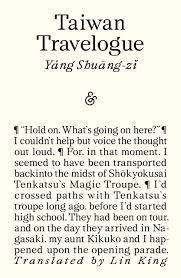
Last time, in a first discussion of Yang Shuang-zi’s novel Taiwan Travelogue, I mentioned that the book’s form conveys information about and is congruent with, the story. It was only a day later that a man came up to me on the street, tears in his eyes, and said, “But what did you mean by that?” Alarmed by random encounters, I hurried away, but ever since, his question has nagged me, and I will attempt to explain. In a story about things not being what they seem, the novel’s introduction is not what it seems to be. It is supposedly written by a Japanese man who possesses a copy of what he describes as the first edition of a book published in 1954 and who provides this to a translator who renders the book into English and publishes it in 2024. None of this is true; it is fiction. There is no Japanese man, the real author of Taiwan Travelogue, Yang Shuang-zi, wrote all of the above; Taiwan Travelogue wasn’t written till 2020.
So the form or structure of the novel communicates information about the content. It is not the random work of typesetters, best B.
If we then approach Taiwan Travelogue as a novel disguised as a sort of memoir, with some sleight-of-hand regarding the introduction (and the afterwards, which we haven’t got to), we should be able to apply concepts about the structure of fiction to it, i.e., how it begins, an inciting incident, progressive complications leading to a climax, leading to an ending showing the consequences of this climax, featuring some transformation of the protagonist. As I said above, in fiction, there are no coincidences (to echo Don Juan, which is always good to do).
Let’s begin.
Last time, I presented the beginning of the purported novel itself, and it’s worth doing so again.
“Hold on. What’s going on here?”
I couldn’t help but voice the thought out loud.
For, in the moment, I seemed to have been transported back into the midst of Shokyokusai Tenkatsu’s Magic Troupe.
I’d crossed paths with Tenkatsu’s troupe long ago, before I’d started high school. They had been on tour, and on the day they arrived in Nagasaki, my Aunt Kikuko and I happened upon the opening parade.”
The narrator then describes the long-ago magician’s parade. Then:
“And here I was, decades later, on the outpost island of Taiwan, reliving this old reverie. It was May, in the thirteenth year of Showa (1938), yet the sights and sounds coursing before me were just like those of Tenkatsu’s Magic Troupe.”
Then, the narrator describes seeing the market area which has evoked a long-ago memory of a magic troupe parade.
‘Kay.
So the novel itself begins with a description of the narrator having an experience in which memory takes her into the past, and she is surprised by this. The past links with the present; two separate realms collide, provoking shock and confusion. (and wonder, I think). The present is disguised as the past and vice versa, providing a neat continuation of the novel’s theme. If we subscribe to the theory that a story’s beginning should resonate at the story’s end, we should expect this theme to re-surface at the end. We’ll see.
After the beginning, we have a section of the story that establishes the characters and provides a sort of steady state for them to exist in prior to the inciting incident. The protagonist, Aoyama Chizuko, is a native Japanese woman, a famous author, who has traveled to Taiwan by ship to write a series of articles or dispatches on the island. The year is 1938; Aoyama’s age is never specified, but she refers to herself as in her forties. She describes how publishers in Japan wanted to send her to Taiwan out of a wish to promote imperialist ideas in Japan. As I mentioned last time, Japan controlled Taiwan in the 1930s and saw at as a central part of its expansion into the southern Pacific. Aoyama is reluctanct to be used as an instrument of Japanese imperialism, and this establishes an important aspect of her character—her rebelliousness. However, she needs money. “The Government-General of Taiwan had always been fond of bringing Mainlander authors to Taiwan, and thus…sent a joint invitation naming Taichu town hall (Taichu is Japanese for the Taiwanese city of Taichung) as my official host. Even without the lectureship compensation, their offer to cover transportation, housing, and dining immediately dispelled all of my financial woes.”
She describes sailing to Taichu and going to a market area where she encounters some difficulty because of not speaking the language. There, for the first time, she meets the woman who becomes her interpreter and companion. The woman says:
“’I beg your pardon—would you like any assistance?’
I followed this flawless Japanese to its source: the face of a petite young woman who came up to around my jaw. Silken cheeks like an infant’s—and two dimples that punctuated them when she smiled.”
Aoyama is clearly smitten with the young woman, but the woman withdraws without saying her name. However, serendipity arranges another meeting; she is O-san, a native Taiwanese who will be Aoyama’s interpreter. This, I think, is the story’s precipitating incident.
“The sudden swelling in my chest made me choke on a lungful of air.”
Aoyama is persistently upbeat and self-deprecating. There are many scenes where she is gently corrected by O-san after making farcical blunders. Aoyama is fascinated by food, and a strong feature of the book is the in-depth description of Taiwanese cuisine. I believe all these features make up her pre-transformation state.
Aoyama is not entirely reliable as a narrator—not because she intentionally misleads the reader but because she is naïve and un-curious. She presents her story in very surface fashion, and we the readers must attend more to the implied author’s work in order to get the story’s meaning. She endlessly describes the charms of O-san but doesn’t reflect on (or at least isn’t shown as reflecting on) the deeper implications—that she is attracted to another woman. Perhaps what is being shown is that her sexuality has been determined long ago and is unsurprising to her. Or it could be that she is spectacularly unaware. Or, it could be that she is an unreliable narrator who “sugar-coats” the story.
Let’s stop there and resume next time.
Till then.
Comments