Amber

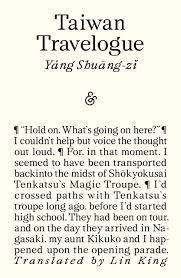
As we approach the end of our stroll through Yang Shuang-zi’s Taiwan Travelogue, it would be good to give further consideration to the intriguing preface and several afterwords, known collectively and formally as paratext.
Our friend A.I. says, “Paratext refers to the elements surrounding a text—such as covers, titles, prefaces, and footnotes—that frame, promote, and help readers interpret it. Coined by Gérard Genette, this "threshold" material, including design and formatting, shapes audience reception.” This also includes peritext—elements inside the book like dedications and footnotes. The whole phenomenon serves to “package” the text and provide context.
Well, sure, AI. I’d say Ms. Yang is a master of using peritext to shape Taiwan Travelogue a certain way, and this, as we know, is the work of the implied author.
Yay!
We’ve talked about the book’s introduction, entitled, ”A Truncated Dream, a Foreign Splendorland,” purportedly written by a Japanese woman (I mistakenly said she was a man earlier) after the year 2015 when she claims to have first become acquainted with the text. Let’s not belabor something we’ve already discussed but point out again that this intro was really written by Ms. Yang around 2020. It states that the text was written around 1954 as a novel based on the author, Aoyama Chizuko’s, 1938 travels in Taiwan. A close and clever reader might say, hmmm, why did the author do this? Why write a novel based on travel experiences? Of course, it is all a fiction, best B. The character Aoyoma Chizuko is a creation of the real author, Ms. Yang, who wanted to give the text a particular meaning—that is, a book that was written long ago, based on the “real’ experiences of a “real” person. Yes, this makes a claim to give the story authenticity but it’s so obviously part of the fiction that one must wonder why? Why did the author give the book this feature?
This feature, which might be called a framing device, gives the reader the impression that several people or voices are telling the story. A sense of polyphony, of a sort of community packaged as a novel. Perhaps, the illusion of being a “real” story contributes to the urgency of the book’s messages—prejudice is wrong, it’s easy to delude yourself by thinking you’re righteous.
After this introduction, there is a page of dedications. However, they are written by the story’s narrator, Aoyama Chizuko, who, as we know, is a fiction. In a self-deprecating manner, she thanks three of the characters in the story as if they were real—including “Miss Ong Tshian-hoh,” Aoyama’s translator and companion, Chi-chan. Well, these dedications continue the illusion that the story was based on real people and narrated by a real person.
Then in the English edition, we have two elegant pencil drawings of the house Aoyama resided in while living in Taiwan. Is this a real house or imaginary? We don’t know. But the drawings were done by Aoyama Chizuko. This whole introductory section is credited to two fictitious people and written, we can only assume, by one real person, Ms. Yang. (Wink, wink).
Let’s look at the afterwords:
The first is credited to Aoyama Yoko, identified as the adopted daughter of Aoyama Chuzuko. She writes a tribute to her mother that is said to have been done in 1970, the same year she says her mother died. Here it is said that Aoyama included the twelfth chapter in a later edition of the novel. This is the final chapter that describes Aoyama seeing Chi-chan one last time.
Then there is a Translator’s Notes section, said to have been written in 1977 in Columbia, Missouri, by Chi-chan. It is claimed in a footnote by Lin Kang, that Wu Cheng-mai, the Mandarin name of Chi-chan’s eldest daughter, published a self-funded and self-translated edition of the book—translated from Japanese to Mandarin Chinese—in 1977. In this note, Chi-chan claims that Aoyama’s daughter Aoyama Yoko visited her at her home in Missouri and showed her the Japanese book Taiwan Travelogues, and the two women exchanged stories about Aoyama Chizuko.
The third afterword is purportedly by Chi-chan’s daughter Wu Cheng-mai and is entitled “Editor’s Note” and written in 1990. It concerns Aoyama’s book and how it came to be published in Mandarin and also tells the tale of Chi-chan’s death.
The fourth offering is by Yang Shuang-zi and is entitled “Translator’s Note,” written in 2020. This piece tells how the author and her sister “discovered” Aoyama Chizuko and got her book published in 2020. She writes: “Why did Aoyama Chizuko choose to rewrite the story as a novel instead of publishing her travel essays on Taiwan as a collection? …would travel/historical writing have been more ‘real?’ Are novels/fiction ‘made-up’ by comparison? …a novel is a piece of amber, one that coagulates both the the real past and the ‘made-up’ ideals. It is something that can be visited again and again in its unparalleled beauty.”
Finally, there is an afterword by Lin King from 2023 about her work translating the story into English.
So what we have is a foregrounded story commented on by a number of voices, not unlike a play where other characters are meta-communicating in asides to the audience. And the story contains two fictional characters who are somewhat hidden and one-dimensional, but who appear in an extremely well-done scene at the book’s end, a scene of forgiveness and letting-go. I think the author’s description of a novel as a piece of amber is a beautiful conclusion. Thank you, Ms. Yang.
Next week, a new one.
Comments